
 Why Data Analytics?
The competitive business market in which we operate presents many challenges that inhibit our ability to plan strategically directly from intuition and experience. Successful businesses are utilizing the power of data and technology to predict future market trends. This enables businesses to stay ahead of the marketplace—gaining a competitive advantage.
My Involvement
During a co-op internship between the City of Montrose and Colorado Mesa University, my objective was to devise a plan to collect at least 10,000 consumer data points in less than 140 hours. It was not a simple task. We encountered many challenges along the way that stalled our progress. One of the largest challenges entailed finding and extracting usable data. Out of nearly 250 businesses considered, only 17 of those housed data that fit the necessary parameters. Furthermore, only four businesses employed ample technology that enabled them to extract their data efficiently.
Thanks to an involved business community and a supportive city management team, we exceeded our goal of collecting ample data that led to the development of the Consumer Analytics Report. This report provides business professionals with statistical data that can help guide them in making strategic decisions.
Deliverables
Consumer transaction data was aggregated with a $10 trillion financial assets database administered by IXI Services. This returned a 72-page document rich with information regarding business and tourism activity in Montrose. Click this link to see the consumer report on page 55.
Target Market Segmentation
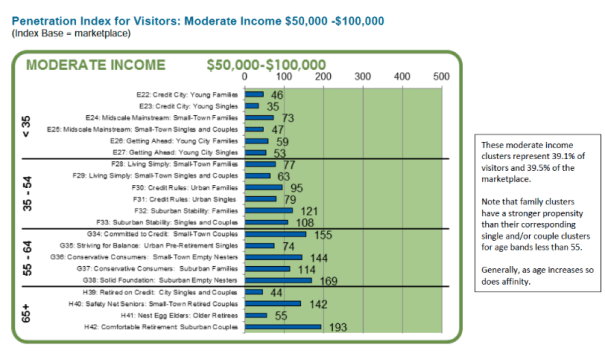
The utility of this consumer report will aid business owners and entrepreneurs for years to come while serving as a benchmark for future growth in Western Colorado. For example, the graph above could assist professionals in developing new business opportunities that support the class “retired suburban couples.” Moreover, this graph could enable aspiring entrepreneurs to develop products and services that fulfill lost market opportunities, such as prospects with young singles and couples.
Geographical Market Prospects
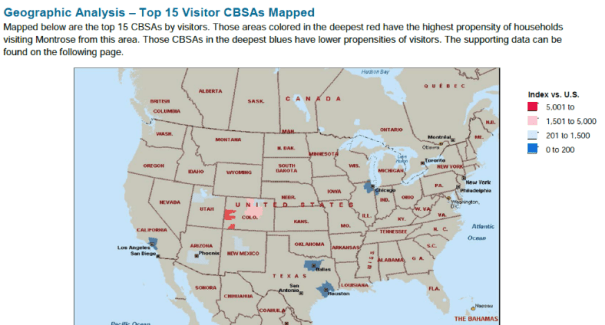
The report also provides insight on consumer geographical activity—answering the question “where do consumers travel from?” This represents potential regions business professionals may target with advertising. Careful analysis of the report suggests five hotspots in North America: Arizona, California, Colorado, New Mexico, Texas, and Utah.
As a business professional, one may utilize the geographical data to determine whether their primary marketing is focusing on tourists traveling from popular geographical regions. Additionally, further market analysis of like demographics in other geographical regions could expand a business professional’s marketing opportunity.
Conclusion
Through my involvement herein, I learned that data is a powerful tool if managed properly. Business data should be exportable in a quick and efficient format. For example, the most efficient data sets utilized here took less than ten minutes to query. Furthermore, this opportunity has equipped me with knowledge of analytical tools that enable me to make calculated strategic decisions for your business—helping you gain a strong competitive advantage.
If my involvement with this project intrigues you, and you wish to further discuss how I can help you implement data analysis into your strategic plan, please contact me today.
Discover more from Improvement Habit
Subscribe to get the latest posts sent to your email.