Changing the way people think about innovation is tough, and figuring out where change fails is even harder. ADKAR just might have some of the answers.
Before reading this book, one must understand that process improvement works best from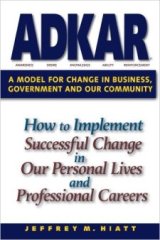 the bottom-up. This entails empowering your front-line employees to make necessary changes in order to enhance their work and life–enhancing the overall organizational system. Moreover, empowering your front-line also involves the evolution of a leader’s ability to embrace change. Thus, change must be successful at all levels of an organization in order to have valid impact. ADKAR helps us guide our impact by understanding where we are strong and where we could use a little polish within each change initiative.
ADKAR stands for awareness, desire, knowledge, ability and reinforcement. Change can fail when there are low rankings in any one of these five categories. These situations are known as barrier points (Hiatt, 2006). “Managing the people side of change is about realizing change faster, with greater engagement (participation levels) and higher proficiency (performance) by all individuals affected by the change” (Hiatt, 2006, p. 47). You will have to read the book to find out how this works.
Jeffrey M. Hiatt, author of ADKAR: How to Implement Successful Change in Our Personal Lives and Professional Careers, is also the founder of Prosci–an organization positioned to train and consult change agents. For more information about Prosci’s offerings, please visit Prosci’s website.
Discover more from Improvement Habit
Subscribe to get the latest posts sent to your email.